You bought a house with a well, and nobody ever explained how it works. Now the pressure is dropping, the pump cycles every thirty seconds, or a lab just told you there is bacteria in your water. You need a straight answer, not a sales pitch.
That is why Aquifer and Pump exists. We write practical guides for private well owners in the US and Canada, covering well pumps, pressure tanks and switches, troubleshooting, water testing, drilling and yield, maintenance and costs.
Our tagline says it plainly: straight answers for your well, from the aquifer to the tap.
Our mission
Help you understand your own well system
Most well owners inherit their system with the house. There is no manual, and the equipment sits in a basement corner or a pit you never open. When something goes wrong, you are choosing between a guess and a service call.
Our mission is to close that gap. Every guide follows the whole system from aquifer to tap: the well itself, the pump, the pressure tank and switch, the treatment equipment and the plumbing to your fixtures. When you can trace a symptom back along that path, you can find the part that actually caused it instead of replacing things at random.
We also believe you deserve honest numbers. Costs in our guides are given as low, typical and high ranges, and we explain the factors that move the price: well depth in feet, access to the casing, pump size in horsepower, flow in GPM and regional labor rates. A fair quote stops being a mystery when you know what drives it.
What you can expect from every guide
- A quick answer box up front: the most likely cause, the first safe check, and when to call a licensed contractor.
- Content organized around the symptom you see, like no water, short cycling or air at the taps, not around product catalogs.
- Concrete numbers where they matter: cut-in and cut-out in psi, tank pre-charge 2 psi below cut-in, depth in feet with metric in brackets for Canadian readers.
- Honest cost ranges with the depth, access and regional factors that move the price.
- A clear next step at the end of every guide, so you know what to do when you finish reading.
How we approach health and safety
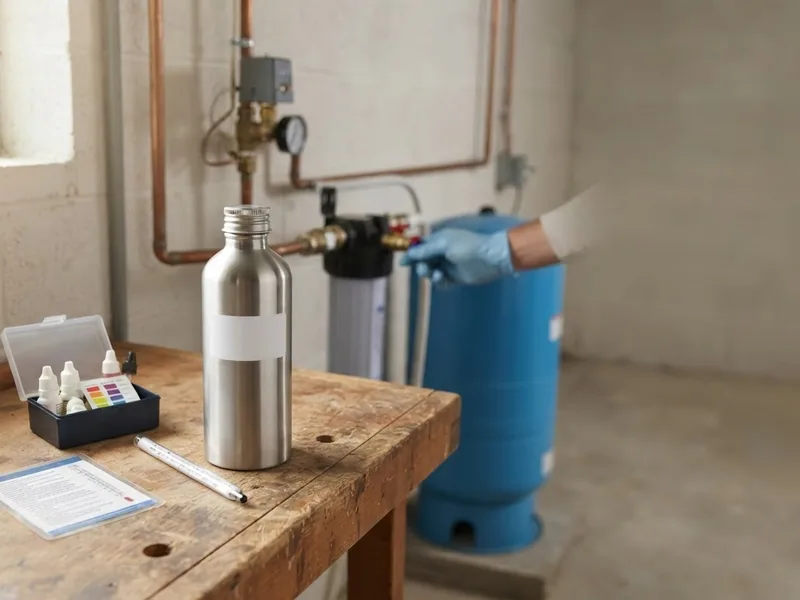
Water quality advice is only useful if the numbers are real. When we talk about bacteria, nitrate, arsenic or any other contaminant, we cite the EPA, CDC, USGS, Health Canada or your state or provincial health department. We never invent limits, and we never round a health standard into something more convenient.
We do not scare you, and we do not downplay real risks. Total coliform in a test result means something different than E. coli. Nitrate is a particular concern for infants. Arsenic is a long-term exposure issue, not an emergency. We explain the difference so you can act at the right level of urgency.
We are just as direct about DIY limits. Some jobs are safe for a careful homeowner, like checking the pressure switch contacts with the power off or measuring tank pre-charge with a gauge. Others are not: 240-volt wiring, pulling a submersible pump from a 200-foot (61 m) well, or working inside the casing. When a job is not DIY, we say so plainly and tell you what to ask a licensed contractor instead.
How guides work
The path every troubleshooting guide follows
Start with the symptom
You search for what you see: no water at the taps, the pump short cycling, air spurting from a faucet, sediment in a glass. The guide is built around that symptom, not around a product.
Read the quick answer box
Right at the top you get the most likely cause, the first safe check you can do yourself, and the point where you should stop and call a licensed contractor.
Trace the system
The guide walks the system from aquifer to tap, explaining the why behind each check. You learn where your symptom can originate, from a low-yielding well to a waterlogged pressure tank.
Decide: DIY or call a pro
Each guide ends with a clear next step. If it is a safe DIY check, you get the procedure. If it is not, you get the questions to ask a contractor and a realistic cost range so you can judge the quote.
Who this is for
Written for well owners, not well drillers
Our readers are homeowners between 30 and 65 in the US and Canada who rely on a private well. Many are first-time well owners who just discovered the pressure tank in the basement. Others are facing a specific problem: a failing pump, a waterlogged tank, a positive bacteria test, or a drilling quote they cannot evaluate.
You do not need any background in plumbing or electrical work to use our guides. We assume the system was never explained to you, because for most well owners it was not. Technical terms are defined when they appear, and every instruction explains why you are doing it, not just what to do.
If you want to know what is wrong, what you can safely fix yourself, what a fair price looks like, and what a lab result means for your family, you are in the right place.
Have a question about your well?
If you cannot find your symptom in our guides, or you want to ask about a specific situation, send us a message. Tell us what you are seeing at the tap or the pressure gauge, and we will point you in the right direction.